JJRadiator Late July Update: SEO Keyword Optimization and 260% Impression Growth
Three weeks after the July 1 baseline, jjradiator.com went from 661 impressions to 2,378. Clicks grew from 41 to 69, and average position improved from 26.5 to 21.1. Here is what I changed based on Search Console data, and what the numbers actually mean.
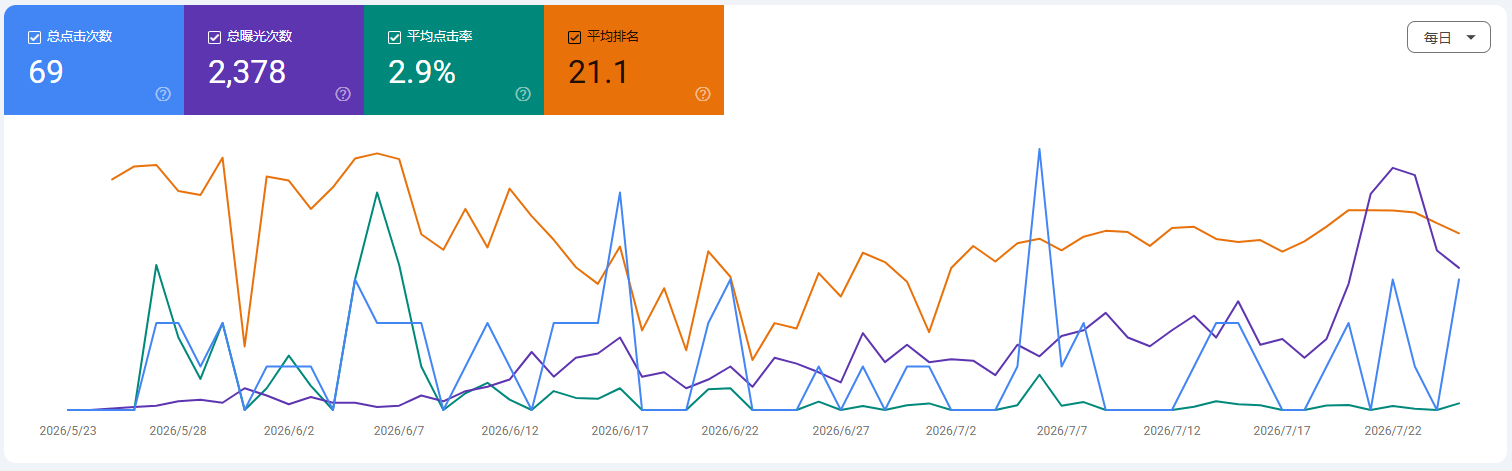
The Numbers: July 1 vs July 22
| Metric | July 1 | July 22 | Change |
|---|---|---|---|
| Clicks | 41 | 69 | +68.3% |
| Impressions | 661 | 2,378 | +259.8% |
| CTR | 6.2% | 2.9% | -3.3pp |
| Avg Position | 26.5 | 21.1 | +5.4 positions |
The headline: impressions nearly quadrupled. Clicks almost doubled. Average position improved by over 5 positions. CTR dropped — but that needs context.
Why CTR Dropped (And Why That Is Fine)
CTR went from 6.2% to 2.9%. On the surface, that looks like a problem. It is not.
When a site is new and small, the impressions it gets tend to come from very specific, long-tail queries — exact OEM part numbers, brand name searches, or narrow product terms. Those queries have naturally high CTR because the searcher knows exactly what they want and your page matches it closely.
As the site gets indexed for broader queries — "radiator supplier China", "auto cooling parts wholesale", "truck radiator tank" — impressions go up fast, but those queries are more competitive and the searcher is less committed to clicking any single result. CTR drops because the denominator (impressions) grows much faster than the numerator (clicks).
This is the same pattern I described in the Month 1 Report. It is a volume effect, not a quality problem. A 2.9% CTR at position 21.1 is reasonable. As positions improve into the top 10, CTR should recover naturally.
What I Changed Based on Search Console Data
The July 1 snapshot was my observation period. After that, I started making changes — carefully, based on what the query data was telling me.
1. SEO Keyword Optimization on Product Pages
I looked at which queries were generating impressions but not clicks, and which product pages were getting the most visibility. Based on that data, I adjusted:
- Title tags and meta descriptions on key product category pages to better match the queries Google was already testing them against.
- H1 headings to include the buyer-intent terms that appeared in Search Console — terms like "radiator tanks supplier", "repair tools for radiator workshops", "filler necks for aftermarket".
- Internal anchor text between product pages and category pages, using the language buyers actually search for rather than generic labels.
2. Updated Product Pages
I refreshed several product category pages with better keyword targeting and more buyer-focused copy. The pages that got the most attention:
- Radiator Tanks — expanded from a simple product list to include application categories (truck, passenger car, generator, heavy duty) and buyer-focused FAQ.
- AC Condensers — added vehicle brand groupings and sourcing guidance for mixed orders.
- Thermostats and Water Flanges — restructured to emphasize cross-category sourcing (buyers who need thermostats often need flanges too).
- Repair Tools — expanded to cover the full toolkit that radiator workshops need, not just individual items.
- Filler Necks and Caps — added material options, application context, and clearer inquiry prompts.
3. New Blog Content for Buyer Intent
I published three new blog posts targeting the kind of questions actual B2B buyers ask:
- "Building a Radiator Order: What to Add to the Same Shipment" — practical advice for buyers who want to maximize container space by adding small, high-value cooling parts.
- "Thermostat and Water Flange: Why Buyers Should Source Them Together" — cross-category sourcing logic that reduces supplier management overhead.
- "Filling the Container: Small High-Value Cooling Parts to Add to a Radiator Order" — a buyer-focused guide to mixed-order optimization.
These are not traffic-bait articles. They target the actual questions I see in customer inquiries — the same questions that should, over time, match search queries.
4. Multi-language Pages Updated
The Spanish (/es/) and Arabic (/ar/) versions of the site were also updated to match the English keyword changes. This matters because a significant share of B2B auto parts demand comes from Latin America and the Middle East.
The Graph: What the Daily Data Shows
The Search Console graph from May 23 to July 22 tells a clear story:
- Impressions show a steady upward trend with visible acceleration in early July, right after the keyword optimization went live. There are peaks around June 7–12 and again around July 7–12, suggesting Google was actively testing new pages against queries during those periods.
- Clicks follow the same pattern but at a smaller scale. The click peaks align with impression peaks, which is the expected behavior — more visibility leads to more clicks, even at lower positions.
- Average position fluctuates but shows a general improvement trend. The site was around position 26.5 on July 1 and has moved to 21.1 by July 22. That is meaningful progress for a site that is only one month old.
- CTR declines as expected — the site is being tested against a wider range of queries, many of which are broader and more competitive than the initial long-tail matches.
What I Learned This Month
- Search Console query data is the best SEO tool you already have. I did not use any paid SEO software. The free Search Console data told me exactly which queries were generating impressions, which pages were being tested, and where the gaps were. Every change I made was based on that data.
- Impression growth is the first signal. In the first month, impressions tell you more than clicks. If Google keeps showing your pages for more queries, it means the site is being discovered and tested. Clicks will follow as positions improve.
- CTR drops are not failures — they are growing pains. A new site that only shows up for exact-match queries will have high CTR. A site that starts ranking for broader, competitive terms will see CTR drop. That is the cost of growth. The fix is not to chase CTR — it is to improve positions.
- Buyer-intent content beats keyword stuffing. The blog posts I wrote are answers to real buyer questions. They are not optimized for a specific keyword density or stuffed with SEO tricks. They are useful. That is the kind of content that earns clicks from the right people.
- Product page structure matters more than word count. The product pages that performed best in Search Console are the ones with clear category headings, proper H1 tags, and buyer-focused descriptions — not the ones with the most text.
What I Will Watch Next
- Whether CTR stabilizes or continues to drop. If CTR drops below 2% without position improvement, something needs to change — either the title tags are not compelling enough, or the site is ranking for queries it cannot serve.
- Which queries drive clicks, not just impressions. The goal is not to rank for everything. It is to rank for the queries that bring actual buyers — people searching for specific OEM numbers, product categories, or supplier terms.
- Indexed page count. With 15,000+ product pages, I need to track how many are actually indexed and whether Google is treating them as useful or as thin content.
- Whether the blog posts start earning their own traffic. The three new posts target buyer-intent queries. If they start getting impressions and clicks independently, it validates the content strategy.
The next snapshot will be around August 5, 2026. By then, the SEO changes will have had a full month to take effect, and the data should be more meaningful than the first two weeks.
If You Are Doing This Too
If you are building a B2B export site and watching your own Search Console data, here is what this month taught me:
- Read your query data before changing anything. Do not guess what keywords to target. Search Console tells you what Google already thinks your pages are about. Start from there.
- Make changes based on evidence, not best practices. "Best practice" says to write long-form content. My data said buyers search for OEM numbers and product categories. I optimized for what the data showed, not what SEO blogs recommend.
- Do not panic about CTR drops. If impressions are growing and positions are improving, CTR will take care of itself over time. The worst thing you can do is rewrite everything because CTR dropped in week three.
- Write content that answers real questions. The blog posts that will eventually drive traffic are the ones that answer questions actual buyers ask in emails and WhatsApp messages. Not the ones written for search engines.
This project is public. The data stays public. The next update will show whether the optimization held up or whether the early growth was a temporary spike.
→ Follow the numbers: Live Stats Dashboard — Search Console screenshots, updated with each new snapshot.
→ Read the full build log: AI Export Lab — every article in this experiment, in order.
→ See the real site: jjradiator.com — the export website this case study is about.